Siding Repair vs Replacement in Warren, MI: How to Decide
Repair and replacement are not two prices for the same job. They are two different jobs, and the wall underneath decides which one your home needs.
Call Now
Describe what your siding is doing and where you are — a local siding professional is connected from there.
Call NowMon–Fri 7:00 AM–10:00 PM ET · Sat 8:00 AM–10:00 PM ET · Sun 7:00 AM–9:00 PM ET
At a glance
Repair and replacement are not two prices for the same job. They are two different jobs, and the wall underneath decides which one your home needs.
Homeowners ask whether to repair or replace their siding as if the two were options on a menu. They are not. Repair and replacement are two different jobs, and the wall underneath decides which one your home needs. A repair fixes a local failure — a cracked panel, a loose lock, a failed flashing — and leaves the rest of the wall alone. A replacement opens the whole wall, inspects the sheathing and the flashing, and puts new cladding on a wall that has been restored. The visit decides which job it is by opening the wall, not by looking at it from the street.
The decision is made sign by sign, and the signs are read together. A single cracked panel is a repair. A cracked panel, a chalked south wall, and a lock that will not hold are a replacement. A stain below a window is a repair — the flashing. A stain below every window is a replacement — the flashing everywhere, and the wall behind it. The line is drawn on your wall, before any work starts, and it is drawn from what the wall shows, not from what the homeowner hopes.
When repair is the right answer
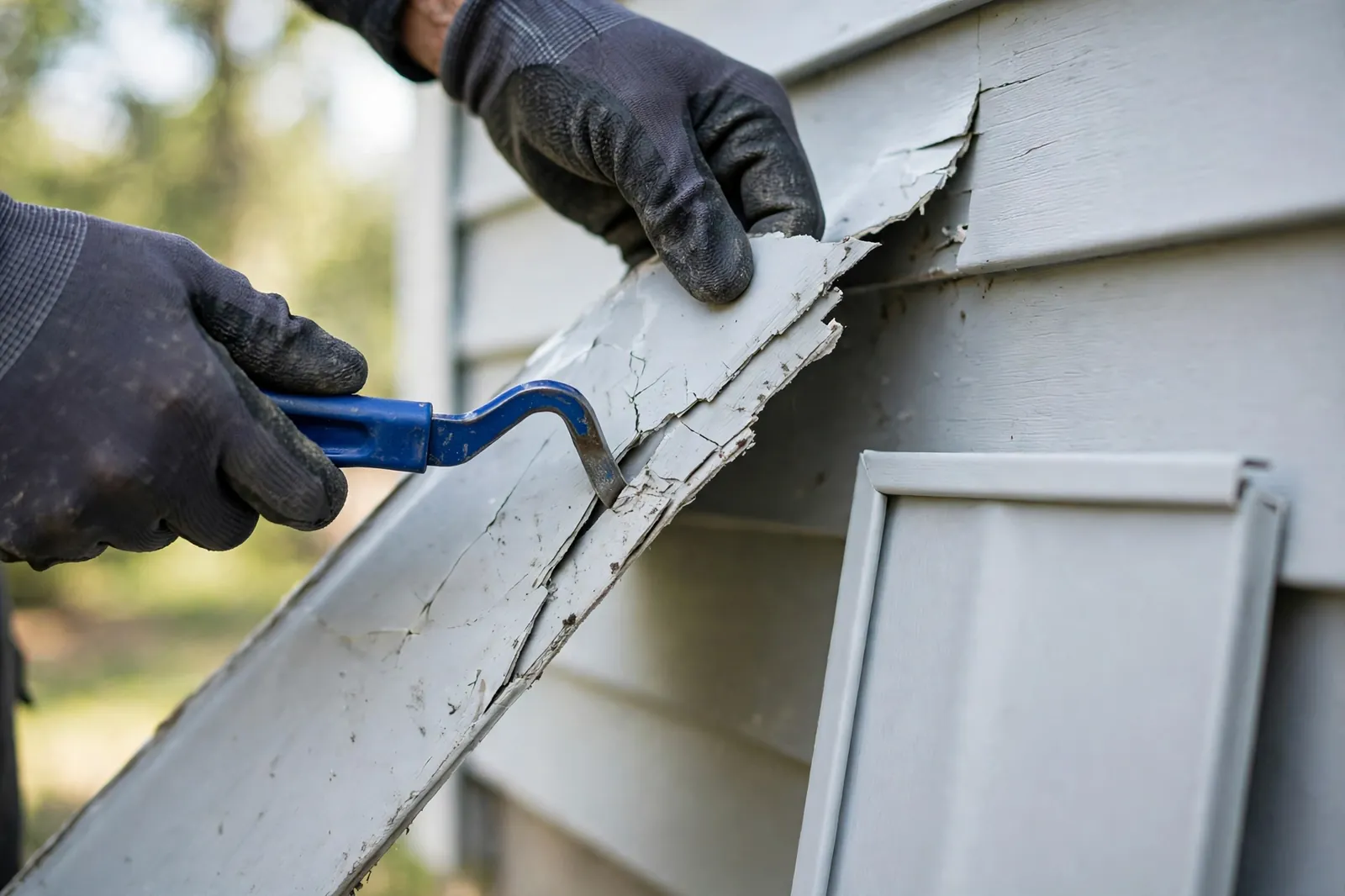
Repair is the right answer when the damage is local and the wall behind it is sound. One cracked vinyl panel, one dented metal panel, one swollen fiber cement board, one loose lock, one failed flashing — each of these is a single failure with a single cause, and the repair fixes the cause and restores the cladding to match the wall around it. The wall behind the repair is inspected at the same time, because the damage may have let water in, and the inspection confirms the wall is sound before the repair is closed.
Repair is also the right answer when the material is young and the failure is new. A vinyl wall that is ten years old and has one cracked panel does not need replacement — it needs a panel, and a check of the panels around it, because the same cold made them brittle too. A fiber cement wall that is five years old and has one peeling joint does not need replacement — it needs the joint rebuilt, and a check of the joints around it. The age of the wall and the spread of the failure are the two facts that decide a repair.
When replacement is the right answer
Replacement is the right answer when the failure is spread across the house. Chalking on every sun-facing wall, cracks at many corners, panels that will not lock in several places, stains that keep returning — these are not local failures, they are a material that has reached the end of its service life, and repairing one panel at a time costs more in visits than a replacement costs in work. The visit draws that line honestly, because a homeowner who repairs one panel a month for a year has paid for a replacement without getting one.
Replacement is also the right answer when the wall underneath has never been inspected and the siding is thirty or more years old. The wall is an unknown — the sheathing, the housewrap, and the flashing have been working for a generation without anyone looking at them — and the only way to know the wall is to open it. A replacement is the moment the wall is finally seen, and what is found there decides the work. A wall that is replaced without being inspected is a wall whose condition is still unknown, and the new panels will fail the same way the old ones did.
What the wall underneath decides
The wall underneath decides the job, and the wall is opened to find out. A test area of cladding is removed, and the sheathing, the housewrap, and the flashing are seen and photographed. Soft sheathing means the wall needs repair before new cladding goes on, whatever the panels look like from the street. Torn housewrap means the drainage path needs repair. A flashing gap means the water path needs correction. Each finding changes the job, and the job is planned from the findings, not from the panels.
The findings are shown to the homeowner before any work starts, because the homeowner is the one who decides — and the decision is easier with the wall in front of you than with a description of it. A soft spot at the bottom course, a stain below a window, a flashing gap at the roofline — each one is photographed, and the repair is planned from the photographs. The wall inspection is the most important part of the job, because it is the part that decides what the job is.
The cost of waiting
Waiting is a decision too, and it has a cost. A cracked panel left through a Michigan winter lets wind-driven rain behind the cladding, and the freeze-thaw cycle works on the sheathing all winter. A loose lock left through a summer of thunderstorms works looser with every gust, until a whole run of panels is flapping. A stain left through a year of rain means a flashing gap that has been leaking for a year, and the sheathing behind it is softer than it was when the stain first appeared.
The cost of waiting is not the repair getting more expensive — it is the repair becoming a replacement, and the replacement becoming a wall repair. A panel repaired in autumn is a panel. A panel left through winter is a panel and a soft sheathing. A panel left through two winters is a panel, a soft sheathing, and a wall that needs to be opened further than it would have been. The visit is simplest when the damage is smallest, and the wall is kindest when it is looked at early.
How the visit decides with you
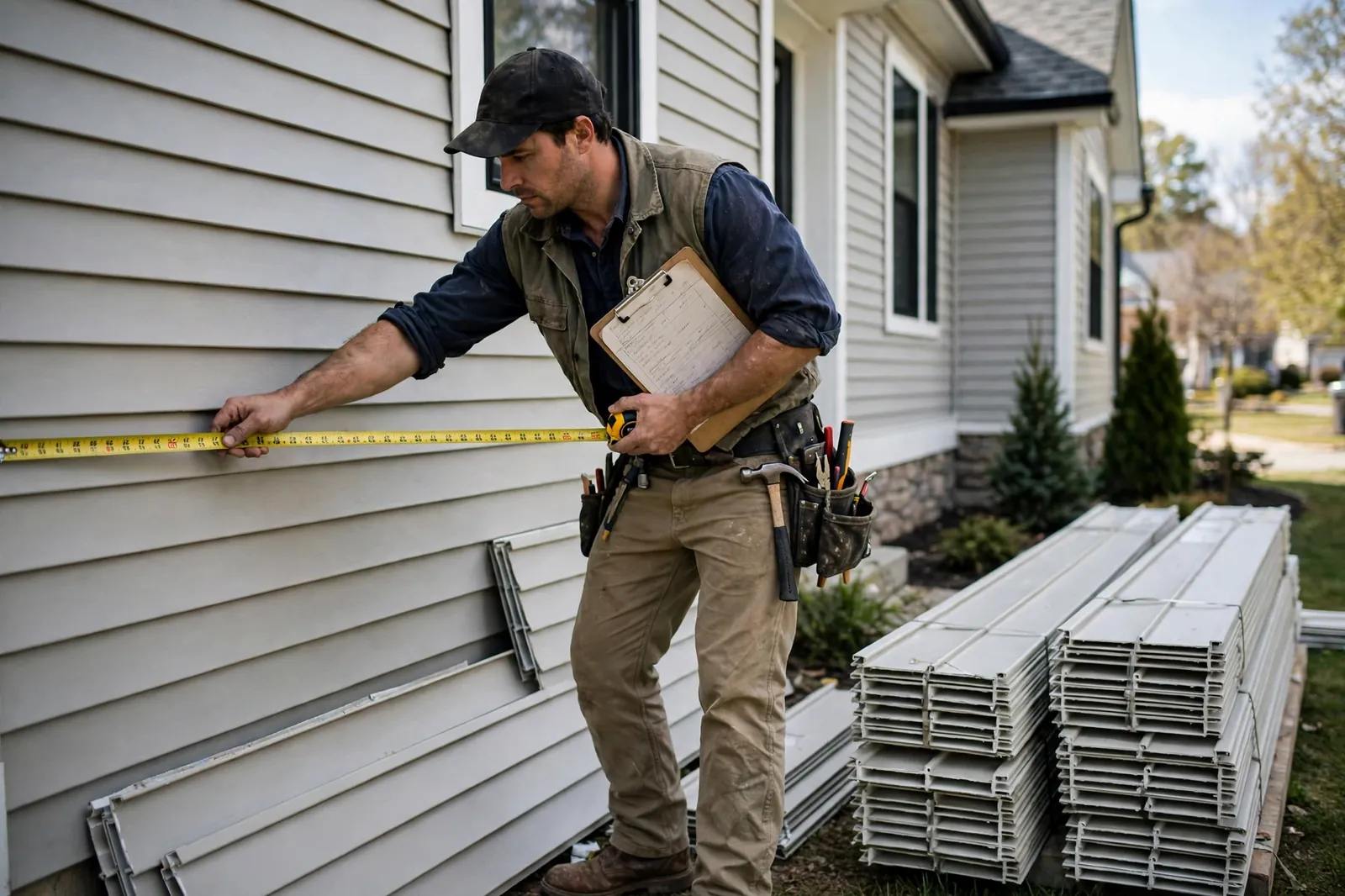
The visit decides with you, not for you. The crew walks every elevation with you, notes the signs in order, opens a test area of cladding, and shows you what the wall looks like underneath. The repair and the replacement are both explained — what each one covers, what each one finds, and what each one leaves unknown — and the decision is made from the wall in front of you, not from a brochure or a guess.
The decision is also reversible in one direction and not in the other. A repair can always become a replacement later, when the next panel fails or the next stain appears. A replacement cannot become a repair — once the wall is opened and the new cladding is on, the wall is the wall for the next generation. The visit says so, because the homeowner who chooses a repair should know it is a choice that can be revisited, and the homeowner who chooses a replacement should know it is a choice that lasts.
A Warren example: the street that decided together
On a 1960s street off Van Dyke, three houses in a row faced the same decision in the same season, because they were built in the same year, sided in the same decade, and weathered the same winters. The first house had one cracked panel and a loose lock — a repair, made in an afternoon, with the wall behind the panel checked and found sound. The second house had chalking on every sun-facing wall, cracks at many corners, and panels that would not lock in several places — a replacement, with the wall opened, the sheathing checked, and the flashing corrected before the new panels went on.
The third house had a stain below every window and a soft spot at the bottom course — a replacement and a wall repair, because the flashing had failed everywhere and the sheathing behind the bottom course was soft. The three houses made three different decisions, and each one was right for its wall, because the decision was made from the wall in front of the crew, not from a rule about age or a guess about the material. The street is the lesson: repair and replacement are not two prices for the same job, they are two different jobs, and the wall decides which one each home needs.
Frequently asked questions
Straight answers to the questions Warren homeowners ask most.
By the spread of the failure and the age of the wall. Repair makes sense when the damage is local — a few cracked panels, one loose lock, a single stained area with a clear source — and the wall behind it is sound. Replacement makes sense when the failure is spread across the house, or when the wall underneath has never been inspected and the siding is thirty or more years old. The visit opens a test area and shows you the wall before the decision is made.
It is cheaper for one panel, and more expensive for a house. When the failure is spread across the house, repairing one panel at a time costs more in visits than a replacement costs in work, and the homeowner pays for a replacement without getting one. The visit draws that line honestly, on your wall, before any work starts.
Yes, when the stain has a single source — a flashing gap above the stain. The repair is the flashing, and the stain is the map that shows where the flashing has failed. When the stain appears below every window, the flashing has failed everywhere, and the job is a replacement with the flashing rebuilt, not a series of single repairs.
Waiting is a decision, and it has a cost. A cracked panel left through a Michigan winter lets water behind the cladding, and the freeze-thaw cycle works on the sheathing all winter. A loose lock left through a summer of thunderstorms works looser with every gust. The repair that is a panel in autumn is a panel and a soft sheathing in spring, and the visit is simplest when the damage is smallest.
Talk about your wall?
One call connects you with a local siding professional for Warren and the towns around it.
Call NowTalk to a local siding professional
One call connects you with a local professional for Warren and nearby towns. Describe what your siding is doing — what cracks, what rattles, what stains — and the visit is arranged from there.
Mon–Fri 7:00 AM–10:00 PM ET · Sat 8:00 AM–10:00 PM ET · Sun 7:00 AM–9:00 PM ET
Service area
Sterling Heights, MI · Troy, MI · Madison Heights, MI · Roseville, MI · Eastpointe, MI · Clinton Township, MI · Shelby Township, MI · Fraser, MI · Center Line, MI · Detroit, MI
Warren Siding Pros is a referral service connecting customers with local siding professionals; it is not itself the service company.