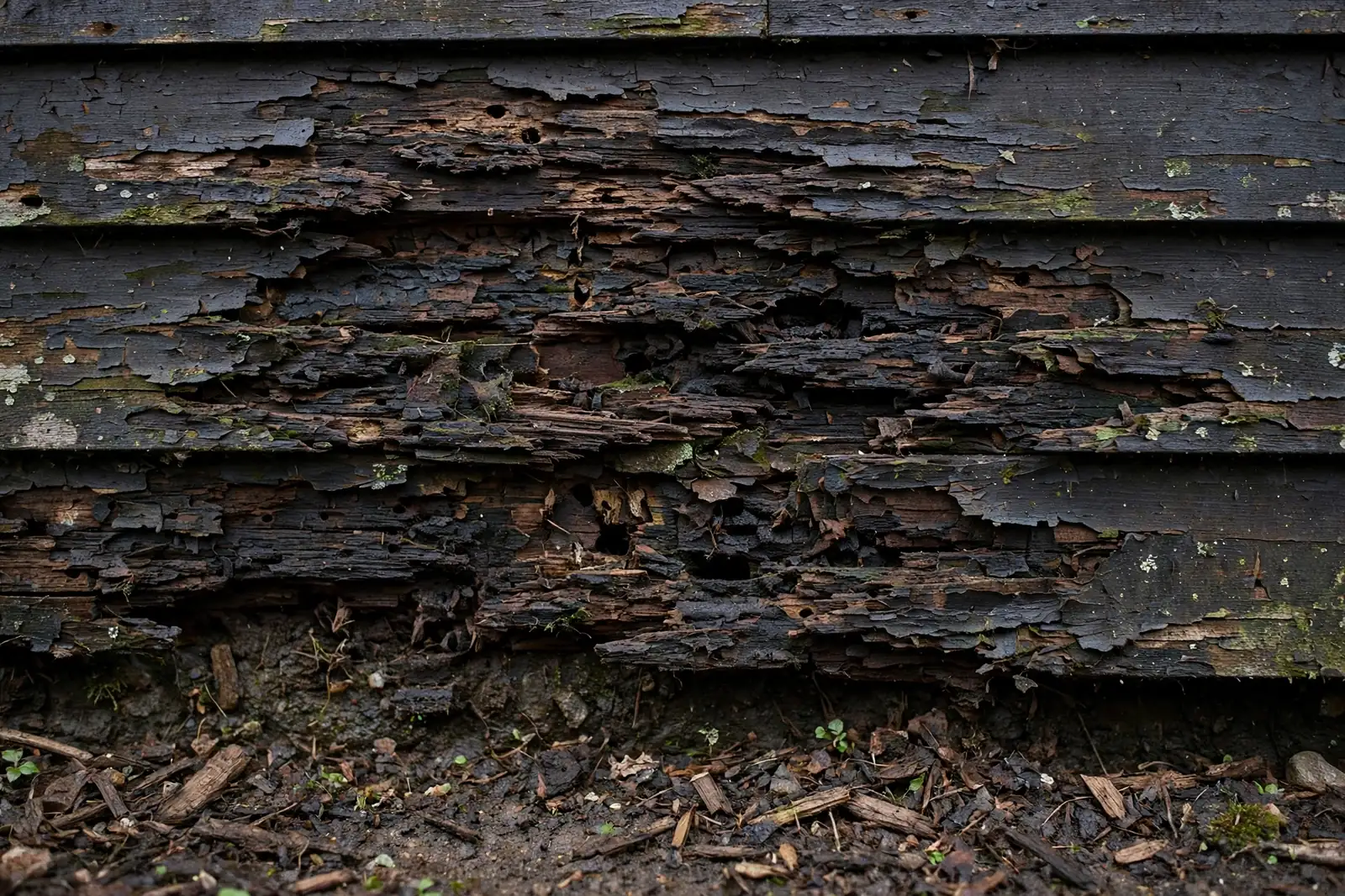
Rotted Siding in Warren, MI
Rotted siding in Warren starts at the bottom edge, where the wall sits closest to splash-back and snowpack, and it works upward from there. The rot is a water problem before it is a siding problem, and the repair that lasts is the one that fixes the water — the clearance, the flashing, and the drainage — not just the board you can see.
Call Now
Describe what your siding is doing and where you are — a local siding professional is connected from there.
Call NowMon–Fri 7:00 AM–10:00 PM ET · Sat 8:00 AM–10:00 PM ET · Sun 7:00 AM–9:00 PM ET
What is rotted siding?
Wood rots when it stays wet. A board that absorbs water and cannot dry will soften, darken, and lose its structure, and the rot spreads from the wettest place outward — the bottom course, the corner, the joint where the flashing has failed. In Warren, the wettest place is the bottom edge, where the wall sits in splash-back from the lawn and snowpack from the driveway all winter, and where the freeze-thaw cycle works on any water it finds.
Fiber cement does not rot the way wood does, but it swells and softens when it absorbs water through an unsealed cut edge or a bottom edge that sits in water. The swelling is the same warning as rot in wood — the board has been wet, and the water has nowhere to go. The repair is the same in both cases: the damaged boards come out, the wall behind them is inspected, and the water path is fixed before new boards go on.
The wall behind rotted siding is the part of the job that matters most, because the rot in the siding is usually a sign of rot in the sheathing behind it. A soft board is found by pressing the wall; a soft sheathing is found by opening the wall. The visit opens the wall at the rotted area, checks the sheathing, and replaces what is soft — because new boards over soft sheathing will rot the same way, from behind.
How rot starts at the bottom edge
The bottom course is where any wood product shows trouble first, because it sits closest to splash-back and snowpack. A bottom edge that sits too close to grade, a deck, or a driveway wicks water up behind the cladding, and the freeze-thaw cycle works on it all winter. The board softens, darkens, and loses its structure, and the rot spreads upward from the bottom course into the course above it.
The fix is clearance and drainage. The bottom edge is set clear of grade and above decks and patios, a flashing directs water out at the bottom of the wall, and the wall is detailed so water has a predictable path out. A bottom edge that is restored without fixing the clearance will rot again — the water source is the grade, not the board.
How rot spreads from a flashing failure
A flashing gap at a window, a door, or a roof-to-wall joint lets water into the wall, and the water runs down behind the cladding until it finds a place to sit — usually the bottom course, or the sill below the window. The rot appears at the bottom, but the cause is at the top, and the repair that only replaces the rotted boards at the bottom will fail, because the flashing above them is still letting water in.
The visit traces the rot to its source. The stain below a window, the soft spot at a roof-to-wall joint, the damp wall on the shaded side — each one marks a flashing gap, and the repair is the flashing. The rotted boards are replaced, but the flashing is the repair.
What is found behind rotted siding
Opening a rotted wall usually finds soft sheathing, and sometimes more. The sheathing behind the bottom course is the first to go, because it sits in the same water as the boards. The housewrap behind the sheathing is often torn or missing, and the framing behind the housewrap is sometimes soft as well. The visit photographs what it finds, so the homeowner sees the wall condition before the repair is planned.
The repair replaces what is soft — the boards, the sheathing, and the housewrap — and restores the drainage path, so the new wall can dry. A wall that is repaired without opening it is a wall whose condition is unknown, and the rot will come back in the same place, under new boards that have to come off again to fix it.
Other wall problems in Warren
Cracked & Warped SidingFaded & Peeling SidingLoose Siding & Wind DamageMoisture Behind SidingDrafty Walls & Poor Insulation
Frequently asked questions
Straight answers to the questions Warren homeowners ask most.
Press the wall near the bottom course and around windows. A sound board is firm; a rotted board is soft and gives under pressure. Other signs are paint peeling in sheets, a board that has darkened or softened, and a musty smell near the foundation. The only certain check is opening the wall and looking at the sheathing behind the boards.
Wood is the most repairable cladding there is. A single rotted board can be cut out and replaced, and a bottom course can be renewed without touching the wall above it. Full replacement makes sense when the rot is spread across the house — soft boards on several elevations, or a wall underneath that needs inspection. The visit draws that line on your wall, before any work starts.
Water that stays against the wall. The bottom edge sits in splash-back and snowpack, a flashing gap lets water into the wall, or a wall that cannot dry traps water behind the boards. In a Michigan winter, wet snow sits against the wall for weeks and the freeze-thaw cycle works on any water it finds. The repair fixes the water — the clearance, the flashing, and the drainage — not just the board.
No. New boards over soft sheathing will rot the same way, from behind, because the water source has not been fixed and the sheathing cannot support the new boards. The wall is opened, the soft sheathing is replaced, and the drainage path is restored before new boards go on. The wall inspection is the repair; the boards are the finish.
Talk about rotted siding on your wall?
One call connects you with a local siding professional for Warren and the towns around it.
Call NowTalk to a local siding professional
One call connects you with a local professional for Warren and nearby towns. Describe what your siding is doing — what cracks, what rattles, what stains — and the visit is arranged from there.
Mon–Fri 7:00 AM–10:00 PM ET · Sat 8:00 AM–10:00 PM ET · Sun 7:00 AM–9:00 PM ET
Service area
Sterling Heights, MI · Troy, MI · Madison Heights, MI · Roseville, MI · Eastpointe, MI · Clinton Township, MI · Shelby Township, MI · Fraser, MI · Center Line, MI · Detroit, MI
Warren Siding Pros is a referral service connecting customers with local siding professionals; it is not itself the service company.