7 Signs You Need New Siding in Warren, MI
Siding rarely fails all at once. It fails one sign at a time — a chalky south wall, a cracked corner, a lock that will not hold — and the seven signs below are the ones a Warren crew looks for first.
Call Now
Describe what your siding is doing and where you are — a local siding professional is connected from there.
Call NowMon–Fri 7:00 AM–10:00 PM ET · Sat 8:00 AM–10:00 PM ET · Sun 7:00 AM–9:00 PM ET
At a glance
Siding rarely fails all at once. It fails one sign at a time — a chalky south wall, a cracked corner, a lock that will not hold — and the seven signs below are the ones a Warren crew looks for first.
Siding rarely fails all at once. It fails one sign at a time — a chalky south wall, a cracked corner, a lock that will not hold, a stain below a window that keeps coming back after washing — and the homeowner who reads those signs early gets a repair, while the homeowner who misses them gets a replacement and a wall repair underneath it. The seven signs below are the ones a Warren crew looks for first, in the order they usually appear.
The signs are read together, not one by one, because a single sign is a repair and several signs together are a replacement. A cracked panel is a repair. A cracked panel, a chalked south wall, and a lock that will not hold are a wall that has reached the end of its service life. The visit reads the signs the same way, and it draws the line with you, on your wall, before any work starts.
Sign 1: Chalking and fading on the sun-facing walls
Run a hand along the south wall. If it comes away with a white, chalky film, the surface of the vinyl has broken down under ultraviolet light. The panel is still hanging, but its surface has aged past the point where it sheds water and holds colour the way it should. The south wall goes first, the west wall next, and the wall under the eaves stays dark because it is shaded — and when the fading is uneven across the house, the material has aged.
Chalking is a surface change, and it is also a map: the most faded wall is the wall that has taken the most weather, and it is usually the first wall the inspection opens. A wall that looks better after washing and then fades again within weeks is a wall whose surface has aged, and the answer is replacement, not another wash.
Sign 2: Cracks at corners and laps
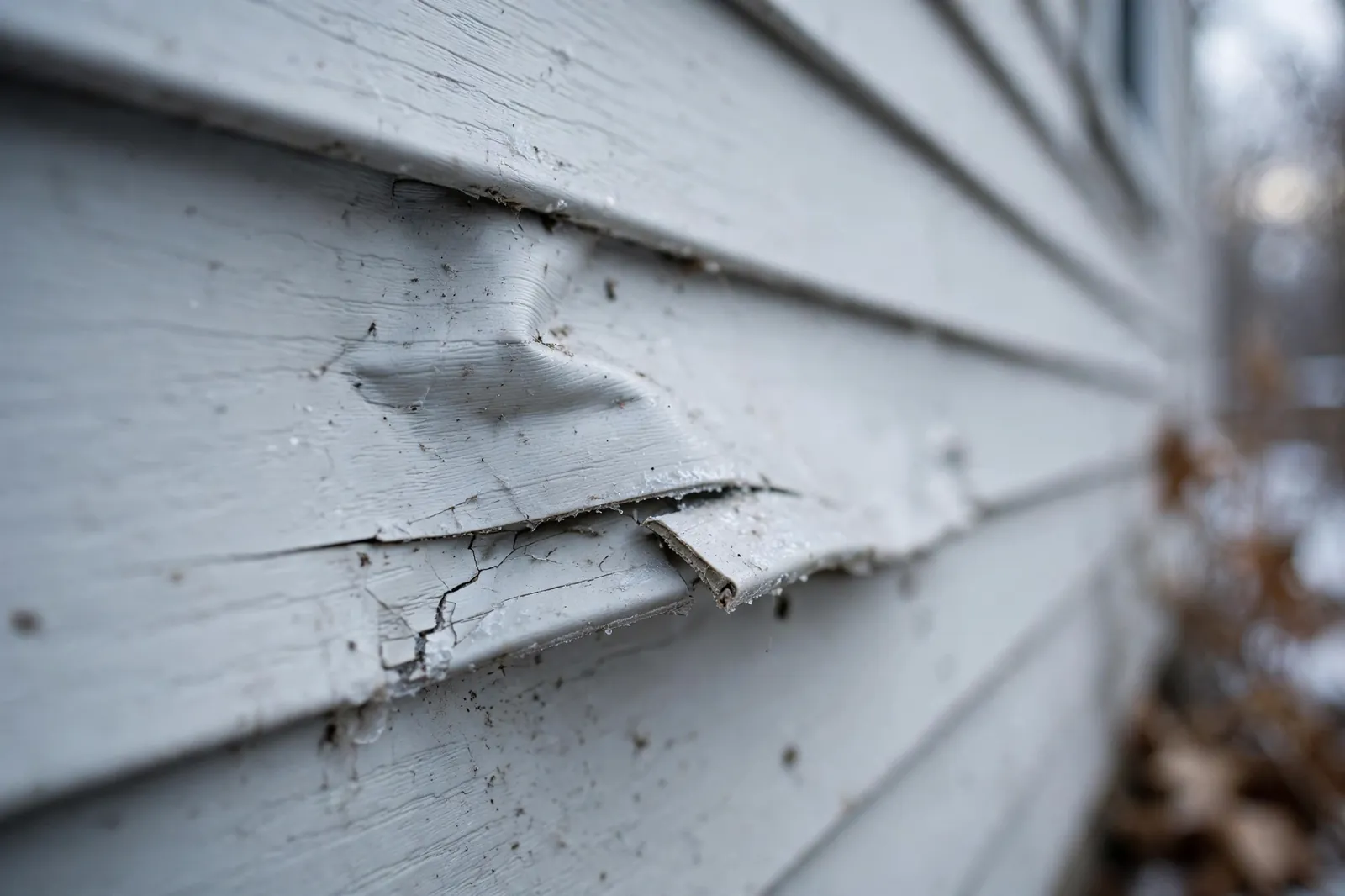
Corners take the worst of wind and ice, and laps are where a panel ends and the next begins. Cracks at either place let wind-driven rain behind the cladding, and in a freeze-thaw climate that water works on the sheathing all winter. Vinyl turns brittle in deep cold, and a ladder foot, a thrown chunk of ice, or a branch in a January wind can crack a panel that would have flexed harmlessly in July.
A single cracked panel is a repair. Cracks at many corners, on several elevations, are a sign the material has become brittle across the house, and the panels around the cracked one are brittle too. The visit checks the panels around a crack, because the same cold made them brittle, and the repair is the panel — with a check of the wall behind it, because the crack may have been letting water in.
Sign 3: Panels that will not lock
A panel whose bottom edge will not stay engaged with the panel below it has usually been pulled out of shape by years of expansion and contraction, or by a nail that was driven too tight. A panel that will not lock is a panel that will rattle, gap, and leak — and a wall where several panels will not lock is a wall whose locks have worked loose across the house.
The repair is the lock and the nailing, not just pushing the panel back into place. A panel that is pushed back without fixing the nailing will come loose again in the next wind, because the cause is still there. When the locks have failed in several places, the nailing is the pattern and the loose panel is the symptom, and the visit checks the nailing on the whole elevation.
Sign 4: Stains that return after washing
A stain that comes back after the wall is washed is not dirt — it is water finding its way out from behind the siding. The source is usually a flashing gap above the stain, and washing the wall only hides it until the next rain. The stain is the map that shows where the flashing has failed, and the repair is the flashing, not the wash.
The stains to watch for are the dark streaks below windows and doors, and the streaks where a roof meets a wall. Each one marks a flashing detail that has failed, and each one means water has been running down the wall behind the siding — sometimes for years — before it found its way out at the stain. The visit traces the stain to its source before any panel is replaced.
Sign 5: Soft spots at the bottom course
Press the wall near the bottom course and around windows. A hollow sound is normal for vinyl; a soft spot is not. Softness means the sheathing behind the panel has lost its structure, and no new panel will fix that until the sheathing is replaced. The bottom course is where a wall shows trouble first, because it sits closest to splash-back from the ground, and it is the first place a wall inspection opens.
A soft spot is the sign that turns a siding job into a wall job. The wall is opened at the soft area, the sheathing is checked, and what is soft is replaced before new cladding goes on. A wall that is sided over soft sheathing will show the same soft spot through the new panels within a season — this time under panels that have to come off again to fix it.
Sign 6: Paint peeling in sheets
When paint comes off in sheets rather than flaking in small pieces, the board underneath is holding water. The paint is failing from behind, not from the sun, and the cause is usually a flashing gap above the peeling area or a bottom edge that has been sitting in splash-back. Painting over peeling paint without finding the water source only repeats the failure — the new paint peels the same way, from behind.
Peeling is the sign that the water problem is in the wall, not on the surface. The visit finds the water source — the flashing, the clearance, the drainage — and the repair is the water path, with the boards replaced only where they have softened. A wall that is painted without fixing the water will peel again, usually within a season.
Sign 7: A wall that has never been inspected
The seventh sign is not on the wall — it is in the wall's history. When the siding is thirty or more years old and the wall underneath has never been inspected, the wall is an unknown, and the only way to know it is to open it. The sheathing, the housewrap, and the flashing have been working for a generation without anyone looking at them, and what is found there decides the work — sometimes a panel job, sometimes a wall job, always a job that starts with the inspection.
This sign is the reason a replacement is worth doing even when the panels still look straight from the street. The panels are the finish; the wall is the structure. A wall that has never been inspected is a wall whose condition is unknown, and a replacement is the moment the wall is finally seen — the sheathing checked, the housewrap repaired, the flashing corrected — before new panels go on.
The walk that tells you
The walk that tells you is the walk you do in spring, after the last snow has melted and before the first warm week. Walk every elevation slowly, from the kerb first and then close to the wall, and look at the bottom course, the corners, and the windows — the places this guide names, because they are the places the wall fails first. Bring a phone and photograph what you find, because a photograph of a crack in April is the record that shows whether the crack has grown by October, and a wall that is photographed is a wall that is watched.
The walk is also the moment to check the inside of the wall, not just the outside. Stand in the rooms on the outside walls and look at the corners, the window frames, and the baseboards — a stain on the inside of a wall is a stain that has come through from the outside, and a cold spot on an interior wall is a wall that is losing heat through a gap the siding has left open. The inside of the wall and the outside of the wall are the same wall, and the signs on one side explain the signs on the other.
Frequently asked questions
Straight answers to the questions Warren homeowners ask most.
One sign is usually a repair — a cracked panel, a loose lock, a single stain with a clear source. Several signs together are usually a replacement: chalking on every sun-facing wall, cracks at many corners, panels that will not lock in several places, or stains that keep returning. When the wall underneath has never been inspected and the siding is thirty or more years old, replacement is also the only way to see that wall.
Washing removes dirt, and it will make a faded wall look cleaner, but it will not restore the colour or the surface. Fading is a surface change in the material itself, not dirt on the surface. A stain that returns after washing is not dirt at all — it is water finding its way out from behind the siding, and the repair is the flashing above the stain.
A soft spot at the bottom course, because it means the sheathing behind the panel has lost its structure, and the wall itself needs repair before new cladding goes on. A soft spot turns a siding job into a wall job, and it is the sign that should not wait — a soft wall left through a Michigan winter will be softer in spring.
Yes, and the check takes ten minutes. Walk every elevation in spring, after the winter, and look for the signs in order: the chalking on the south wall, the cracks at the corners, the locks that rattle, the stains below the windows, and the soft spots at the bottom course. A wall that is looked at every year is a wall whose problems are found as repairs, not as replacements.
Talk about your wall?
One call connects you with a local siding professional for Warren and the towns around it.
Call NowTalk to a local siding professional
One call connects you with a local professional for Warren and nearby towns. Describe what your siding is doing — what cracks, what rattles, what stains — and the visit is arranged from there.
Mon–Fri 7:00 AM–10:00 PM ET · Sat 8:00 AM–10:00 PM ET · Sun 7:00 AM–9:00 PM ET
Service area
Sterling Heights, MI · Troy, MI · Madison Heights, MI · Roseville, MI · Eastpointe, MI · Clinton Township, MI · Shelby Township, MI · Fraser, MI · Center Line, MI · Detroit, MI
Warren Siding Pros is a referral service connecting customers with local siding professionals; it is not itself the service company.