What Is Insulated Vinyl Siding?
A vinyl panel with a layer of foam fixed to its back — one addition that changes how the wall feels, sounds, and holds heat through a Michigan winter.
Call Now
Describe what your siding is doing and where you are — a local siding professional is connected from there.
Call NowMon–Fri 7:00 AM–10:00 PM ET · Sat 8:00 AM–10:00 PM ET · Sun 7:00 AM–9:00 PM ET
At a glance
A vinyl panel with a layer of foam fixed to its back — one addition that changes how the wall feels, sounds, and holds heat through a Michigan winter.
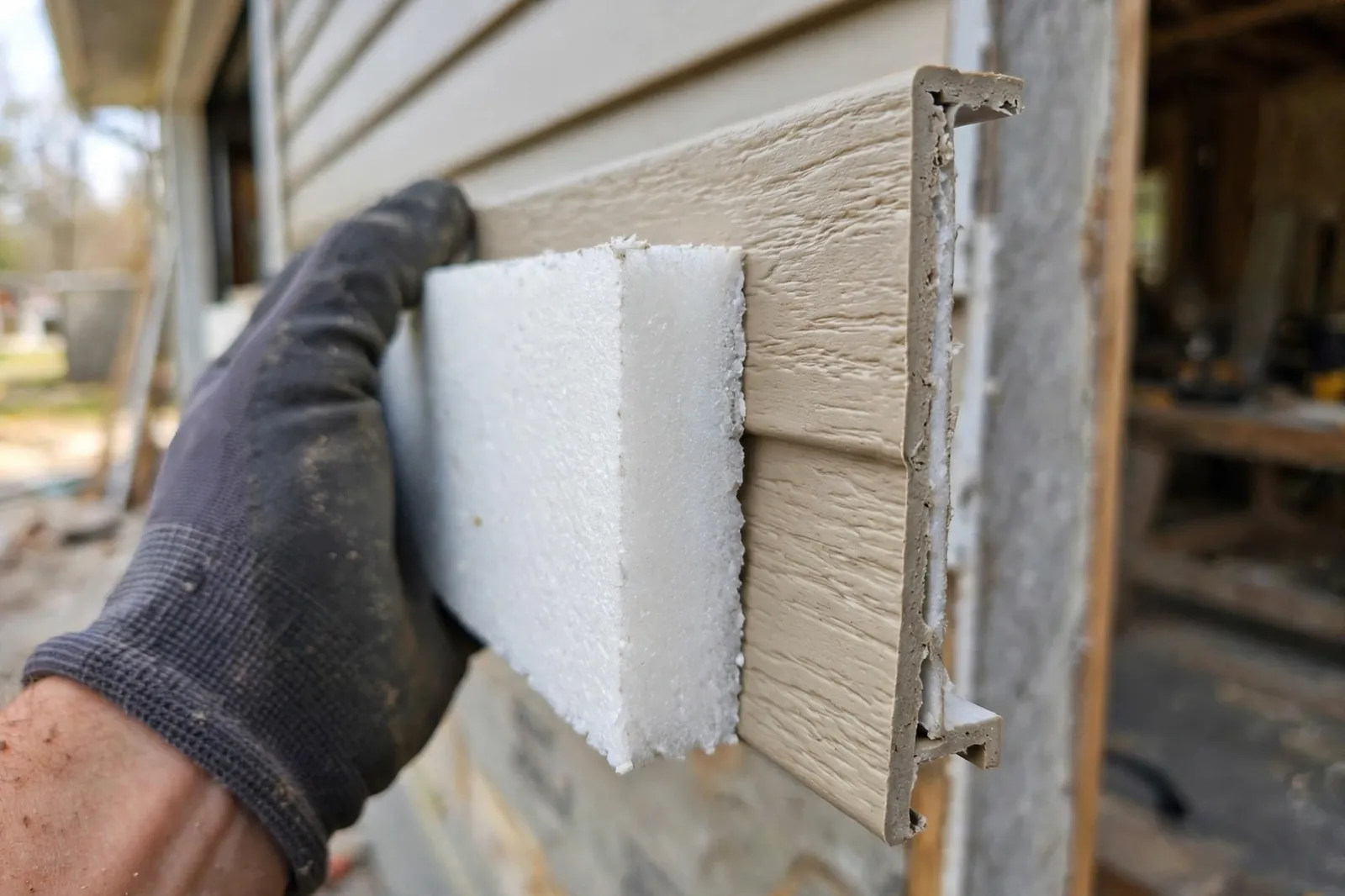
Ask three Warren homeowners what insulated vinyl siding is and you will get three versions of the same answer: vinyl, but with something behind it. The something is a shaped layer of foam, fixed to the back of each panel before the panel ever reaches the wall. The panel and the foam arrive as one piece, go up as one piece, and work as one piece — and every claim made for the product traces back to that single addition.
This guide answers the question in plain terms: what the foam is, what it changes, and what it leaves unchanged. Vinyl is still vinyl — a plastic panel that grows in summer heat and shrinks in January cold, hung loose on its nails so it can move. The foam does not rewrite those rules. It adds stiffness, it deadens sound, and it covers the framing. The sections below take each of those in turn, then the cases where the upgrade is the wrong spend for the wall in front of you.
The foam, and how it joins the panel
The foam is a contoured sheet, moulded to follow the shape of the panel it backs — the same curves, the same laps, the same profile, so the two sit together with no gap between them. It is bonded to the panel at the factory, not added on site, which is why the product arrives as a single board: vinyl on the face, foam on the back, handled and cut as one. On the wall the foam sits against the sheathing or the housewrap, filling the hollow that a plain vinyl panel leaves behind it.
The bond matters because the foam only works while it stays in contact with the panel. A foam sheet that separates, or a panel cut so the foam no longer follows the profile, leaves a hollow again — and a hollow panel drums in wind exactly like a plain one. The crew checks the bond as the panels come off the stack, and any panel whose backing has parted is set aside rather than hung. It is a small check, and it is the one that decides whether the wall sounds solid or hollow when the job is done.
Stiffness, sound, and heat — the three changes
Stiffness is the change you see. A plain vinyl panel is thin and flexible; it follows the wall behind it, and a wavy wall shows through it as a wave. A foam-backed panel is rigid enough to hold its own line, which makes it read as solid from the street — but also means it will not hide a crooked wall. The visit levels the wall before the panels go on, because a stiff panel on a wavy wall looks worse than a flexible panel on the same wall, not better.
Sound is the change you hear. A plain vinyl wall is a drum skin: wind across it, a ball against it, a panel working loose, and the noise carries into the rooms on that side. The foam damps the panel, the way a hand on a drum damps the skin, and the wall goes quiet. Homeowners mention this first on the walk-through, usually by tapping the wall and listening to the difference.
Heat is the change you feel — and the one most often overstated. The foam adds a thin, unbroken layer over the framing, and the framing is where a 1960s wall loses heat: the studs are solid wood from inside to outside, cold lines running through the wall at regular intervals, and the insulation between them never covers them. The foam covers those lines. It does not fill the cavities, it does not seal the gaps around a window, and it does not turn a cold room warm. It takes the edge off the cold spots, and the room notices it in January, when the wall is at its coldest.
The Michigan winter test
Southeast Michigan gives the product its hardest test: more than a hundred freeze-thaw cycles in a single winter, with the temperature crossing freezing 25 to 35 times a month from November through March. Each crossing pushes water a little deeper into any gap it has found, and each freeze widens it. The foam does not change that cycle — what it changes is the panel's response to it. A stiff panel holds its line through a January wind instead of oil-canning on a sunny wall, and a panel that holds its line keeps its locks engaged, which keeps wind-driven rain out of the wall.
The cold still sets the rules for handling. Below freezing, vinyl turns brittle, and a backed panel is no exception — it is heavier, stiffer, and just as easy to crack if it is cut carelessly or forced into a lock. The crew widens the expansion gaps in cold weather, cuts with a light hand, and works one elevation at a time so no wall stands open to snow. A winter installation is workable; a rushed one is not, and the difference shows in the first spring, when a panel that was forced in cold weather works loose.
When the upgrade earns its place — and when it does not
The upgrade earns its place on the walls that show the symptoms it treats: a room that runs cold against an outside wall, a wall that drums in a lake wind, a 1960s ranch whose wall insulation is thin and whose studs are cold lines through it. On those walls the foam is felt on the first cold morning after the job, and the difference is worth the material. The west wall that takes the wind, the north wall that never sees winter sun, the bedroom over the crawlspace — those are the elevations where the backing does its work.
It does not earn its place on a wall that has none of those symptoms. A newer home with modern cavity insulation and a straight wall gains little from a foam backing, and the material is a poor spend there. A wall with open air leaks gains little either — the leaks are fixed when the cladding is off, by sealing the gaps the inspection finds, and no foam layer seals a gap. The visit's job is to say which wall you have, because the honest answer is sometimes that the standard panel is the right panel, and the foam is a detail the wall does not need.
What to watch while the crew works
Watch the wall before the panels go on. The crew should walk every elevation with a straightedge, marking the high and low spots, and level the wall where it needs it — a stiff panel will show every wave the flexible panel hid, and levelling after the panels are up is not possible. Ask what was found behind the old cladding, and look at the photographs of the sheathing and flashing before the new panels cover them.
Watch the locks and the gaps as the panels go up. Each panel should click fully into the one below it along its whole length — a lock that is only half engaged is a panel that will work loose in the first wind — and the nails should sit centred in their slots, driven loose enough that the panel can slide. In cold weather the expansion gaps at the ends should be visibly wider than in summer. The finished wall, walked at the end of the job, should read as straight from the kerb and sound solid when tapped. If it does not, say so while the crew is still there.
The first winter after the job
The first winter is when the homeowner learns what the foam did and did not do. The January morning test is simple: touch the inside of an exterior wall, on the west side and on the north side, and compare it with the winter before. The wall will still be cool — it is an outside wall in Michigan, and no cladding changes that — but the cold spots that used to sit over each stud will be less distinct, and the room will hold its heat a little longer after the furnace stops. The change is a matter of degrees, not a transformation, and a homeowner who expects a transformation will be disappointed by the thermostat rather than the wall.
The other test is the windy night. A plain vinyl wall talks in a lake wind — a rattle here, a drum there, a panel working in its lock — and the sound carries into the rooms on the windward side. A backed wall is quiet, and the quiet is the change the homeowner notices without looking for it. What the first winter does not change is the maintenance: the locks are still checked after a storm, the bottom course is still cleared of snow and mulch, and the wall is still walked in the spring, because the foam is a layer on the wall, not a cure for the wall.
Frequently asked questions
Straight answers to the questions Warren homeowners ask most.
It is an ordinary vinyl panel with a shaped foam layer bonded to its back, arriving and going up as a single piece. The foam stiffens the panel, deadens the sound of the wall, and adds a thin unbroken layer of insulation over the framing. The panel is still vinyl underneath, so it still expands and contracts with temperature and is still hung loose on its nails.
It takes the edge off the cold spots, which is a narrower claim than warming the rooms. The foam covers the studs — the solid wood lines through the wall that cavity insulation never reaches — so the inside of an exterior wall feels less cold to the touch. It does not fill the cavities or seal air leaks, and a room that is cold because of a leak or missing insulation stays cold until those are fixed during the wall inspection.
Often, yes, because that is the wall the product was made for: thin cavity insulation, cold stud lines, and rooms that run cold in January. The backing is felt on the first cold morning after the job. On a newer home with modern wall insulation the difference is smaller, and the visit says so — the product earns its place on the wall that shows the symptoms, not on every wall.
The panels are heavier and stiffer, so they are handled and cut with more care, and the wall behind them is levelled first, because a stiff panel shows a wavy wall. The nailing is the same — centred in the slot, driven loose, with room to slide — because the panel still moves with temperature. The foam changes the stiffness, the sound, and the insulation; it does not change the movement.
It can, with cold-weather handling. The panels are cut with wider expansion gaps in the cold, handled gently because the material is more brittle below freezing, and the crew works one elevation at a time so no wall stands open to snow. The wall inspection matters even more in winter, because frozen sheathing hides soft spots that only show when the wall thaws.
Talk about your wall?
One call connects you with a local siding professional for Warren and the towns around it.
Call NowTalk to a local siding professional
One call connects you with a local professional for Warren and nearby towns. Describe what your siding is doing — what cracks, what rattles, what stains — and the visit is arranged from there.
Mon–Fri 7:00 AM–10:00 PM ET · Sat 8:00 AM–10:00 PM ET · Sun 7:00 AM–9:00 PM ET
Service area
Sterling Heights, MI · Troy, MI · Madison Heights, MI · Roseville, MI · Eastpointe, MI · Clinton Township, MI · Shelby Township, MI · Fraser, MI · Center Line, MI · Detroit, MI
Warren Siding Pros is a referral service connecting customers with local siding professionals; it is not itself the service company.